


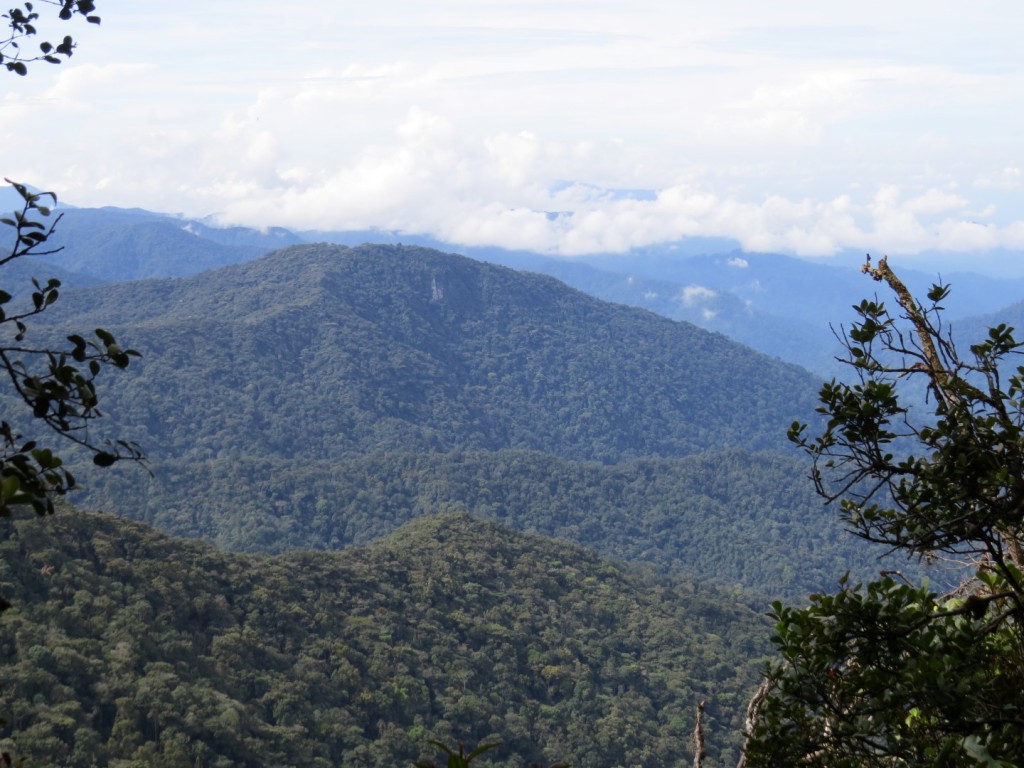

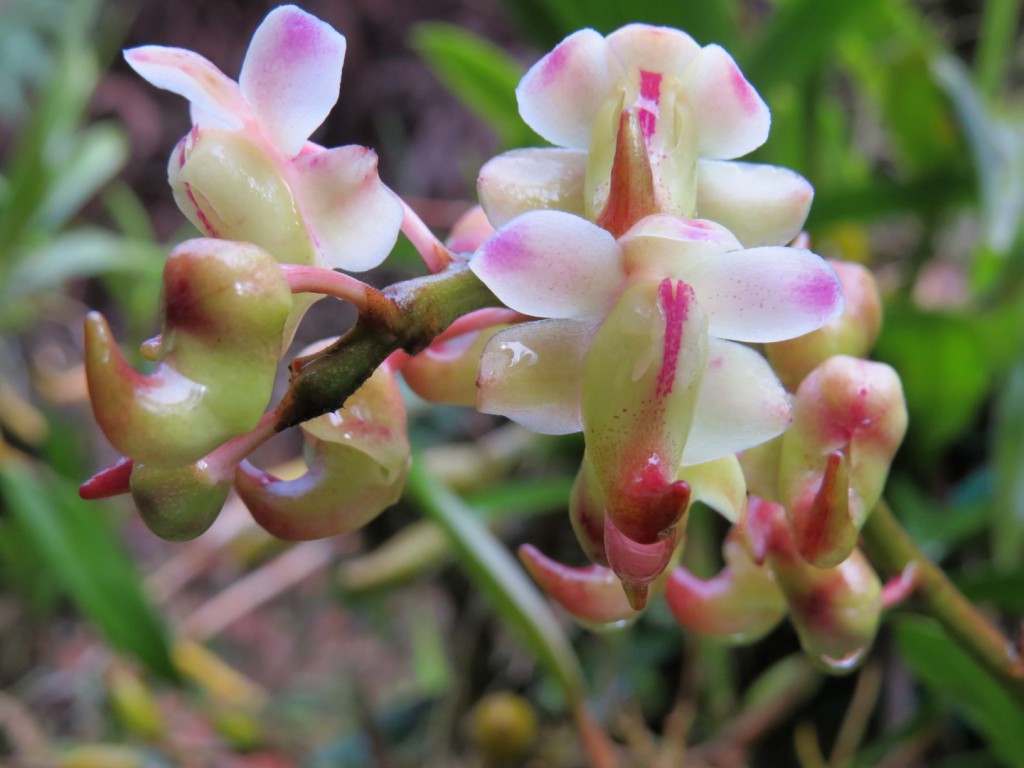


Volunteer Feedback – Erica Jenkins (10-14 Jan 2012)
I just wanted to say thank-you very much for the opportunity to volunteer with REACH. Even though I was only here for a short time, I found it very interesting. I appreciated that you gave me some tasks that were based on my experience with ecology and data analysis, and also that you let me participate in working with local kids, which was something new for me. The kids were a blast, and the data set was fascinating, so all in all in was a good way to spend a few days in the Cameron Highlands. The best part was meeting people who live in Malaysia and the Highlands, it was a much richer experience than the normal tourist route, and I especially appreciate you showing me around and sharing your knowledge of C.H.
Summary of Weather in the Cameron Highlands
By: Erica Jenkins ( ericasjenkins@gmail.com )
Miss Erica Jenkins is a marine biologist from Canada who volunteered with REACH from 10-14th January 2012.. During her short attachement she helped us with data entry and analysis of the weather pattern in Cameron Highlands. We would like to thank her for her much needed help.
There are two weather stations in the Cameron Highlands, one is located at 1472 meters above sea level; data from this station is available dating back to Janauary 1951. Another station is located at 1545 meters above sea level, and data from this station dates back to April 1983. The data collected at these stations includes precipitation, temperature, relative humidity, wind speed, and evaporation. The following report summarizes these data.
Precipitation
Data from the station at 1472 m indicates that the mean yearly rainfall is 2539 mm, with an average of 224 rain days per year. The greatest amount of precipitation occurs during October and November, with mean monthly rainfall of 334 mm and 298 mm, respectively (Figure 1). Another peak in yearly precipitation occurs in April and May; the mean rainfall in April is 275 mm, while the mean in May is 271 mm. The least amount of rain fell in January, with and average of 109 mm, and February, with an average of 115mm of rain per year.

Figure 1. Mean monthly rainfall.
Since the year 1951, based on 5-year running averages, it appears that rainfall was greater in the years from 1951 until 1972, while rainfall tended to be lower from 1973 until 1990, and then again increased in the years 1991 to 2000 (Figure 2). The average rainfall was 2608 mm/yr from 1951 to 1972, 2392 mm/yr from 1973 to 1990, and 2653 mm/yr from 1991 to 2000. This change in mean precipitation may be related to long term climate patterns. A similar pattern has been observed in the Pacific Ocean, and is known as the ‘Pacific Decadal Oscillation’.
Patterns observed at the second weather station, which is at 1545 meters above sea level, were generally quite similar to those patterns observed at 1472 meters. The mean yearly rainfall from the years 1983 to 2000 was 2788 mm/yr, with an average of 237 rain days. The greatest amount of rain fell in October/November, with another peak in April/May, while the least rain fell in January and February. The average rainfall from the year 1984 to the year 1990 was lower (2620mm) than from the years 1991 to 2000 (2905mm). There tended to be more precipitation at the higher elevation (Figure 3); on average there was 227 mm more rain per year at the higher station and the difference was significant based on a two-tailed, paired t-test (p < 0.001).

Figure 2. Mean yearly rainfall.

Figure 3. Mean precipitation, higher and lower weather stations.
Temperature
At the weather station located at 1472 meters, temperature data exists for the years 1965 to 2000. Unfortunately, some of the data was missing at the time of writing this report, and as a result, the data summarized includes the average maximum temperatures from the years 1965 to 2000, the average minimum temperatures from the year 1965 to 1999, and the average temperature from the year 1965 only to the year 1987. The average temperature for these years (1965 to 1987) was 17.8 °C, while the average minimum temperature (1965 to 1999) was 14.8 °C, and the average maximim temperature (1965 to 2000) was 22.3 °C (Figure 4).
Regression analysis of the relationship between the year and the average temperatures (mean, minimum, and maximum) demonstrated a significant positive relationship for both the mean minimum and mean maximum temperatures (Figures 5/6). There was no significant relationship between the year and the mean temperature, but this might be due to the missing data points. Based on these analyses, it appears that there has been an increase in the average maximum and minimum temperatures in the Cameron highlands since the 1960’s. This increase may be related to changes specific to the Cameron Highlands, such as development and reduced forest cover. It is also most likely related to global climate change; the trend observed is very similar to trends observed in other parts of the world. For example, temperatures have increased on the west coast of Canada since the 1940’s in a very similar pattern, there was a peak in temperature in the year 1998 in both this data set and one for the northeastern Pacific Ocean (this information is based on work done for my thesis, and on network of weather stations along the west coast of BC). The data set for the Cameron Highlands is interesting and would benefit from further analysis using advanced time-series analysis techniques and further comparisons to warming trends in similar locations.

Figure 4. Mean temperature at 1472 m in the Cameron highlands including mean maximum temperature and mean minimum temperature (some data missing for the years 1988 to 2000).

Figure 5. Mean minimum temperature in the Cameron Highlands at 1472 m altitude from the years 1965 to 1999.

Figure 6. Mean maximum temperature in the Cameron Highlands at 1472 m altitude from the years 1965 to 2000.
At the higher altitude weather station, temperature data is available from the year 1984 to the year 2000. The mean temperature was 17.9 °C, the mean minimum temperature was 15.3 °C, and the mean maximum temperature was 22.2 °C. There was a significant positive relationship between the year and the mean maximum temperature (Figure 7), which suggests that the average temperature highs are getting higher in this area. There was not a significant increase in the overall mean temperature, which may be due to the low power of this test (only 17 data points) or it may be an indication that although the average temperature has not increased significantly since 1984, the degree to which the temperature fluctuates has increased. Again this may be a result of localized, small-scale changes in the climate (due to changes in the ecosystem such as development and forest clearing), or changes related to global climate change, or a combination of the two.

Figure 7. Mean temperature, mean minimum temperature and mean maximum temperature in the Cameron Highlands at 1545 m altitude from the years 1984 to 2000.
Comparing the two weather stations, the one at 1472 m and the one at 1545 m, some interesting trends emerge. It appears that while the mean minimum temperature at the two altitudes are similar until the year 1991, they then diverge, and the mean minimum temperature at the higher altitude is warmer than at the lower altitude (Figure 8). This result is somewhat counter-intuitive, as one would expect the higher altitude to have lower minimum temperatures, but the result might be related to microclimatic effects such as cloud cover. Conversely, the mean maximum temperatures are higher at the lower altitude site until the year 1991, when they appear to converge (Figure 9). This suggests that after 1991 the mean maximum temperature was higher at the higher altitude (as highlighted earlier in Figure 7). The difference in average temperature (as opposed to average max or average min) is not discussed here, as there were too few data points for the mean temperature at each elevation for the same year (only 4 years where the data is available for both elevations).

Figure 8. Mean minimum temperature in the Cameron Highlands at 1472 m and 1545 m altitude from the years 1984 to 2000.

Figure 9. Mean maximum temperature in the Cameron Highlands at 1472 m and 1545 m altitude from the years 1984 to 2000.
The trends in temperature may be related to the trends observed in rainfall; the rainfall increased in the early 1990’s, and perhaps these data indicate a climate shift that occured around this time. Climate shifts occuring on a decadal scale are not uncommon in other parts of the world, including the northeastern Pacific Ocean, as previously discussed.
Relative Humidity
Data for relative humidity is available only from the weather station at altitude 1542 m, and from the years 1984 to 1997. The yearly average relative humidity at the weather station was 90.4% for the years 1984 to 1997. The average maximum relative humidity for these years was 98.8%, and the average minimum relative humidity was 71.6%. Regression analysis suggests that the mean maximum relative humidity and the mean relative humidity may have increased over the years from 1984 to 1997 (Figure 10), but these results were not statistically significant (p-value > 0.05). More data could potentially lead to a statistically significant increase in relative humidity.

Figure 10. Mean relative humidity, mean maximum relative humidity, and mean minimum relative humidity at 1542 m in the Cameron Highlands from 1984 to 1997.
Windspeed
Windspeed was recorded in the Cameron Highlands at an elevation of 1545 m from the year 1984 to the year 1999. The average windspeed was 2.0 m/s, and the highest recorded windspeed was 27.9 m/s, which was recorded in November of 1998. The year 1990 had the highest average windspeed of 2.2 m/s, and the year 1984 had the lowest at 1.7 m/s (Figure 11).

Figure 11. Average windspeed in Cameron Highlands at 1545 m from 1984 to 1999.
Windspeed was highest during the months of December and January with at average of 2.8 m/s, and windspeed was lowest in the months from May to August, with an average of 1.5 m/s (Figure 12). The wind direction was generally from the Northeast (50°) in the months from January to March, and the wind direction was from the West (275°) from May to October (Figure 13).

Figure 12. Average windspeed (m/s) for each month in the Cameron Highlands at an elevation of 1545 m for the years 1984 to 1999.

Figure 13. Average wind direction (degrees) for each month in the Cameron Highlands at an elevation of 1545 m for the years 1984 to 1999.
Daily Evaporation
Daily evaporation was recorded in the Cameron Highlands at an elevation of 1545 m from the year 1984 to the year 1999. The average daily evaporation was 2.0 mm/day, and the year 1990 had the highest average daily evaporation of 2.3 mm, and the year 1999 had the lowest at 1.6 mm (Figure 14). Daily evaporation was highest during the month of March with at average of 2.5 mm, and evaporation was lowest in the month of November, with an average of 1.6 mm (Figure 15).
Data was available for the years 2009 and 2010 concerning the windspeed and daily evaporation. The average windspeed was 1.9 m/s in 2009 and 1.8 m/s in 2010, and the daily evaporation was 1.9 mm in both 2009 and 2010; these were very close to the averages for the year 1984 to1999, which were 2.0 m/s windspeed, and 2.0 mm evaportion.

Figure 14. Average daily evaporation (mm) in Cameron Highlands at 1545 m from 1984 to 1999.

Figure 15. Average daily evaporation (mm) for each month in the Cameron Highlands at an elevation of 1545 m for the years 1984 to 1999.
14 Jan 2012 Special Kids’ Programme at Sg. Pauh

It was a Saturday like none other, it had been raining heavily the whole week …. so imagine everyone’s surprise and the prayers of thanks when the day started out with the brighest sunshine Camerons has had in days 🙂 (p.s in rained again on Sunday so guess the break in the weather was really due to allow this programme to be conducted as planned)
The kids arrived bright and early and our activities began with actions songs. When asked what songs they knew by heart… believe it or not it was the Negara Ku. So we all stood and sang it out loud, Was a nice change to hear the kids sing it with pride and not have to be forced as I remember that when I taught secodary school kids I had to force them to sing and often they would just lip synch it.

These kids are indeed very Special; even with their limitations they participated in all the activities with eager enthusiasm. They sang, marched, played a recycle game and even took a short walk into the jungle trail. They had a good time and one could see that they enjoyed being in the outdoors.REACH would like to thank the volunteers Angeline (for coordinating the programme with Rumah Kanak-kanak Khas Pembelajaran Tanah Rata), the parents and teachers from the home, Saras Melody and Erica for making this a truly special day and not forgetting thank God for the great sunny day:)
08/01/12 Biodiversity Centre -Getting the foundations right: The 2nd Stage
Last Saturday, the 7th January 2012, a few of us went up to the Biodiversity site at Gunung Brinchang to get the foundations of the Nissen Huts right-literally. The rains had stopped for a couple of days and we decided to brave the steep road and drive up using the President’s four wheel vehicle. But things have a habit of not proceeding smoothly. Hardly 12 feet up the road, we heard a nasty ‘cra-anng’. Apparently the shaft broke. We all scrambled out for our dear lives! (except the driver, of course.) In our haste we went down the road (below the vehicle) but the rescuer amongst us shouted, “ Hey, go up the road! ” Of course. How silly of us. We wouldn’t want the vehicle to tumble onto us. After much huffing and puffing, we reached the construction site. We double checked the foundations for the Nissen Huts, dimensions of the buildings including the toilets and took measurements for the placements of the water tanks, solar panels and wind mill. Yes, a week ago, a solar engineer from Germany was kind enough to visit the centre and advise us on renewable energy sources for the biodiversity centre. We were indeed fortunate to have his expert advice. As for the vehicle, it remained stuck where we left it. While one of us waited for the mechanic, the rest of us took a long walk back to the main road, past the scenic tea estates and past plantation workers loading the day’s harvest onto trucks. It was an interesting day indeed.


Membership
3. MEMBERSHIP (as extracted from the Constitution)
3.1 Full member
3.1(a) Membership shall be opened to all Malaysian citizens who live, work or own property in the Cameron Highlands who is above 18 years of age.
3.1(b) Group Membership may be opened to lawfully constituted Body not less than ten members duly registered with the Registrar of Companies Malaysia, operating in Cameron Highlands.
3.2 Life Member.
Any person as per rule 3.1 (a) shall apply to be a life member of the association.
3.3 Associate Member.
Any other individual as per rule 3.1(a) or registered Body as per rule 3.1(b) may choose to become an “Associate member of the Society” without any voting rights and they shall pay half the subscription of full members.
3.4 Every application for membership shall be forwarded to the secretary who
shall at the first opportunity submits it to the committee for approval. The committee may at its discretion reject any application without assigning any reason thereof
3.5 Every applicant whose application has been approved as aforesaid shall,
upon payment of the prescribed yearly subscription, be admitted as a member of the
Society and shall be entitled to all the privileges of membership.
4. PRIVILEGES OF MEMBERSHIP
4.1 Members on paying their dues will participate in activities of the Society and contribute to the preservation of the environment in Cameron Highlands, uphold the mission and objectives of the Society.
4.2 The voting rights of members shall be determined by the membership type.
4.2.1 A Full Member shall be entitled to vote and hold office in the committee.
4.2.2 A Group Full Member shall be represented by one representative and is entitled to vote and hold office in the committee.
4.2.3 Associate, student and outstation members shall not have any voting rights nor eligible to hold office in the committee.
5. ANNUAL SUBSCRIPTION AND OTHER DUES
5.1 An entrance fee of RM ten (RM10.00) is charged with each application.
5.2 The annual subscription payable according to the type of membership:-
5.2.1 Individual Full member shall pay RM ten (RM10.00).
5.2.2 Individual Associate Member shall pay RM five (RM5.00).
5.2.3 Group Full Member shall pay RM hundred (RM100.00).
5.2.4 Group Associate Member shall pay RM fifty (RM50.00).
5.2.5 Life member shall pay RM 200 (RM200.00) in one lump sum and shall be exempted from paying annual subscription.
5.3 Subscriptions shall be payable to the Treasurer on joining and thereafter
within fourteen days of the first of January of each year.
5.4 Any member who fails to pay the annual subscription within two months of expiry of his membership shall receive a written reminder signed by or on behalf of the Secretary, and shall be denied the privileges of membership until the subscription is paid.
5.5 Any member, who fails to pay the annual subscription within three months of expiry, shall automatically cease to be a member of the Society.
5.6 Upon payment of the subscription in arrears, the Committee may reinstate to his/her membership of any person who has allowed his/her membership to lapse through nonpayment of the subscription.
5.7 Special subscription or levies for particular purposes may be raised from members by resolution of the General Meeting of the Society. If any member fails to pay such subscription within such a period as may be resolved, the amount due shall be treated ia the same way as arrears of subscription.
6 RESIGNATION
Any member who wishes to resign from the Society shall give two weeks notice in writing to the Secretary and shall pay up all dues.
How to become a Member/Renew membership
- Download the membership form/renewal form
- Choose the type of membership applicable
- Complete the membership form/renewal form and attach proof of payment.
- Payment can be made in the following ways:
- a) Cheques/Bankers’ Cheque/Bank Draft made payable to
Regional Environmental Awareness Cameron Highlands and send to REACH Mailing address (as provided below) - b) Payment banked directly into REACH Account at Maybank No.506 043 603 231 Swift Code: mbbemykl and fax/email bank-in slip to REACH
- c)Make an appointment with REACH’s Office Manager to make the payment.
5. Proof of Payment and Membership Form
Please send proof of payment and the duly completed membership/renewal form to REACH with the following particulars for receipts to be issued and posted:
Name, I/C Number,Mailing Address, Email Address, Contact Number .
6. Please call REACH should you not receive your receipt within a month.
REACH Mailing Address:
Regional Environmental Awareness Cameron Highlands
No, 1, Main Road , Brinchang ( top floor)
39100 Cameron Highlands,
Pahang, Malaysia
Contact:
Phone/Whatsapp : +6 012-7564665
Phone/Whatsapp : +6 012-2051117
Email: office@reach.org.my
p.s – Once you become a member please don’t forget to continue to renew membership or better yet sign-up as a life member.